
A website platform decision can either support your growth strategy or create an expensive obstacle six months from now. The real question in the headless CMS versus WordPress debate is not which platform has more features. It is which option gives your business the best path to stronger search visibility, faster marketing execution, and more qualified leads.
For many businesses, WordPress remains the practical choice because it combines publishing control, established SEO tools, and manageable costs. A headless CMS can be the better investment when you need a high-performance digital experience across multiple channels and have the development resources to support it. The winning choice depends on your growth model, not on hype.
What separates a headless CMS from WordPress?
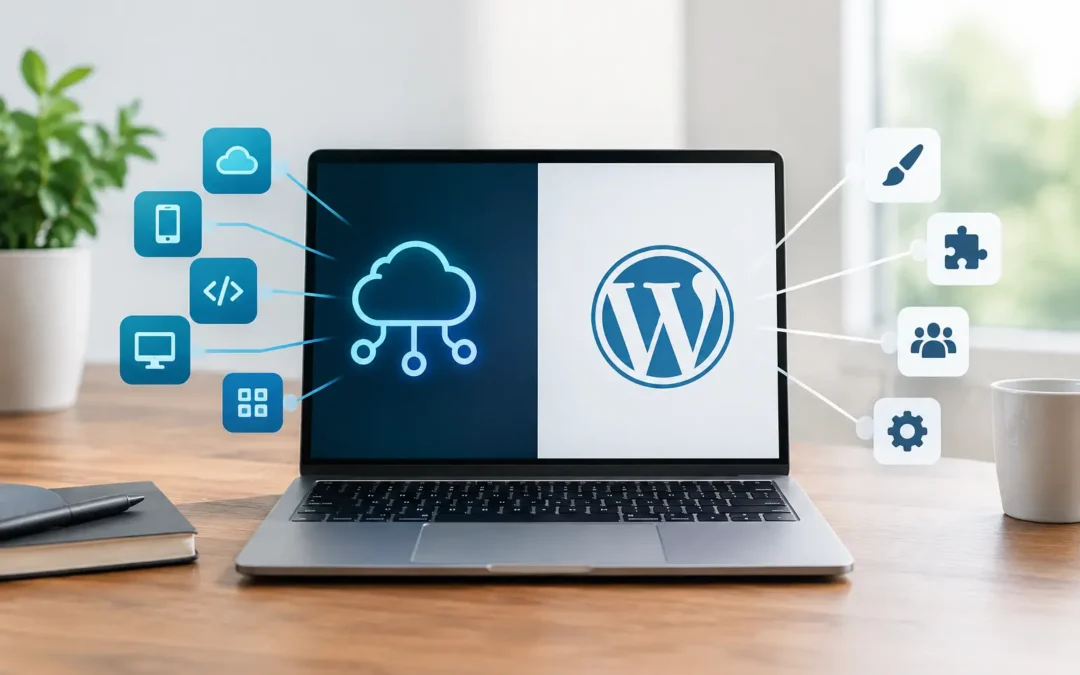
WordPress is traditionally a monolithic CMS. Its content management system, website theme, presentation layer, and publishing tools work together in one environment. Your marketing team can write a page, optimize metadata, add images, publish content, and see how it will look without involving a developer for every change.
A headless CMS separates the content backend from the frontend website. The CMS stores and organizes content, then sends it to a website, mobile app, customer portal, digital display, or other channel through an API. The frontend is custom-built, often with modern frameworks such as React, Next.js, or Vue.
That separation creates flexibility. It also creates more moving parts. A headless CMS is not automatically better because it is newer or more technical. It gives capable teams more control, but control comes with implementation costs, maintenance requirements, and a greater need for disciplined technical oversight.
Headless CMS versus WordPress for SEO
Search performance does not come from a CMS label. Rankings come from useful content, technical accessibility, authoritative links, local relevance, fast page experiences, and a site structure that makes sense to both visitors and search engines. Still, your platform can make those fundamentals easier or harder to execute.
WordPress has a major advantage for businesses that need SEO work to move quickly. Marketers can create service pages, publish location content, improve title tags, update internal links, manage redirects, add schema tools, and optimize images from a familiar admin area. With the right build and a disciplined plugin strategy, WordPress gives a marketing team significant control without requiring a developer for every routine improvement.
Headless sites can deliver exceptional performance, particularly when the frontend is engineered carefully and content is delivered through a fast global infrastructure. They can also be built with clean code and minimal overhead. Those advantages may improve Core Web Vitals and create a stronger user experience, both of which support conversion performance.
But headless SEO is not automatic. Developers must intentionally handle server-side rendering or static generation, XML sitemaps, canonical tags, redirects, structured data, image optimization, metadata fields, and preview environments. A small oversight can create crawlability issues or slow down content production. If your SEO team has to submit a development ticket to change a page title or launch a local landing page, your competitors may gain ground while you wait.
When WordPress is the stronger business decision
WordPress is often the smarter choice for small and mid-sized businesses, local service companies, professional firms, and organizations that rely on frequent content and campaign updates. It is a proven platform for websites built to rank, convert, and evolve.
Choose WordPress when your team needs to launch landing pages quickly, publish ongoing blog content, manage local SEO pages, or test offers without a custom development cycle. It is especially effective for companies that depend on organic traffic and lead generation but do not need their content distributed across apps, software products, and multiple digital interfaces.
The platform also offers a broad talent pool. That matters when you need support, improvements, integrations, or a new developer years after launch. A custom headless build may be excellent, but it can become difficult to maintain if it relies on a narrow technology stack or one specialized provider.
WordPress does require standards. Too many plugins, weak hosting, unmaintained themes, and careless customization can create security and performance problems. Those are not reasons to avoid WordPress. They are reasons to use a professionally built, SEO-focused WordPress environment with ongoing updates and monitoring.
When a headless CMS earns its higher investment
A headless CMS makes sense when content needs to travel far beyond a standard marketing website. Think of a business with a website, mobile app, partner portal, product catalog, multilingual content operation, and in-store digital experience. Managing the same content once and delivering it everywhere can be a serious operational advantage.
It is also worth considering for organizations with complex design requirements, high traffic demands, or a product team already working in a modern JavaScript ecosystem. A headless approach can give developers freedom to create tailored digital experiences without being constrained by a traditional theme structure.
For example, a large manufacturer may need technical product data published to a public site, dealer tools, and sales applications. A growing software company may need its marketing website to work closely with a web application. A media brand may publish to web, mobile, newsletters, and connected devices. In cases like these, headless architecture can reduce duplication and create a more consistent content operation.
The catch is clear: headless projects need a budget for custom frontend development, quality assurance, hosting architecture, API integrations, and ongoing maintenance. Content editors may also need more training. If the business only needs a high-converting website and an efficient way to publish SEO content, that investment may not produce a proportional return.
Speed, flexibility, and the conversion question
Businesses sometimes frame this choice as speed versus usability. That is too simplistic. Both platforms can be fast, flexible, and conversion-focused when they are planned correctly.
A poorly built headless site can be slow, difficult to edit, and full of technical debt. A well-built WordPress site can be fast, secure, visually distinctive, and easy for a marketing team to run. The platform is only one part of performance. Hosting, frontend code, caching, image management, form handling, analytics, call tracking, and conversion strategy all matter.
What matters most is how quickly your business can turn market insight into action. Can you build a campaign page when paid search data reveals a high-intent keyword? Can you create a new service page when competitors are outranking you locally? Can your team test headlines, improve forms, and track which channels generate real revenue?
For lead generation, a website should operate as part of a connected growth engine. That means accurate analytics, CRM integration, conversion tracking, clear calls to action, and reporting that identifies which pages and campaigns produce qualified opportunities. Neither headless nor WordPress replaces that strategy.
Consider the real cost of ownership
The sticker price of a website build rarely tells the full story. Compare the cost over three years, including development, hosting, security, plugin or platform fees, content changes, feature updates, technical support, and marketing team time.
WordPress usually has a lower entry cost and lower ongoing cost for routine marketing tasks. It can provide a faster return when your priority is improving rankings, building lead-focused pages, and expanding content coverage. Headless may cost more upfront, but it can become efficient at scale when one content operation powers many destinations.
Avoid choosing either option based on a demo alone. Ask who will make changes after launch, how long common updates take, what happens when a plugin or API fails, how redirects are managed, and whether your internal team can publish without breaking page layouts. Those answers reveal more than a flashy homepage ever will.
Make the platform serve the strategy
Start with your business goals. If you need to win more local searches, grow service-area visibility, launch campaigns faster, and turn website traffic into calls or form submissions, WordPress is often the direct and commercially sound answer. It gives marketers the control to keep improving the asset that drives visibility and leads.
If your organization needs a custom digital ecosystem with content distributed across several channels, a headless CMS may give you the architecture to scale without rebuilding everything later. Just make sure the technical ambition is tied to a real operational need.
At WYK Web Solutions, the focus is not selling a platform for its own sake. It is building a website foundation that supports rankings, traffic, attribution, and measurable lead generation. Choose the system your team can actively use, improve, and turn into a competitive advantage – then keep investing in the content and conversion work that moves the revenue needle.