
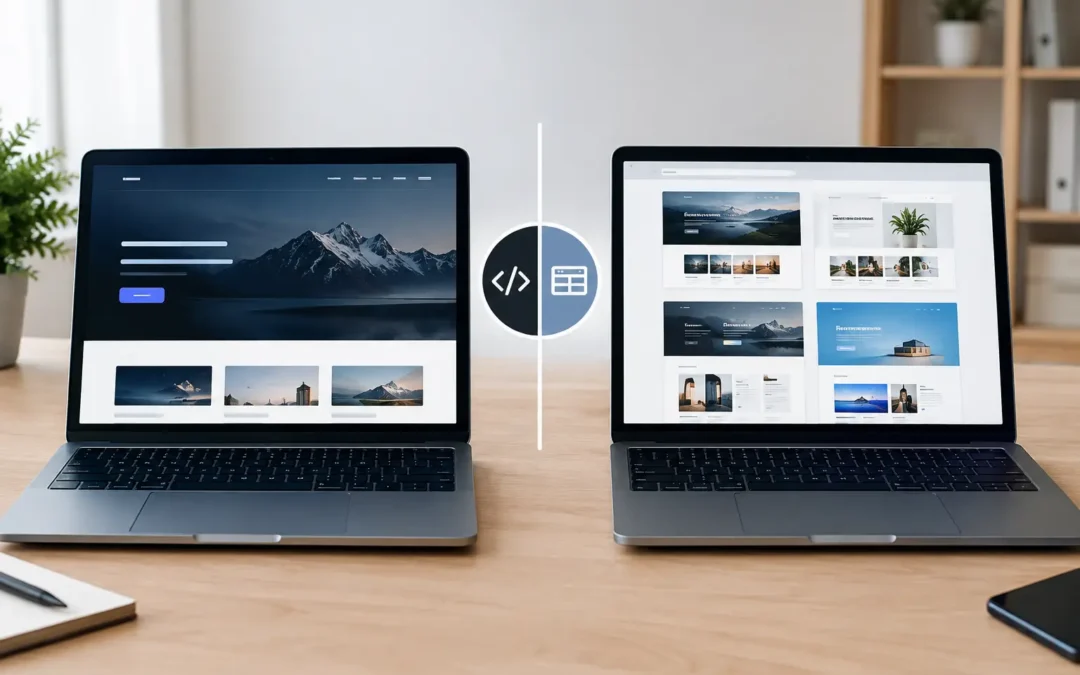
A template website can get your business online by the end of the week. That sounds attractive until your competitors are ranking above you, your contact form produces weak leads, and every important change requires a workaround. The custom website versus templates decision is not really about design preference. It is about whether your website will operate as a real lead-generation asset or remain a basic digital brochure.
For small and mid-sized businesses, both options have a place. The right choice depends on your competitive market, growth goals, marketing plan, budget, and how much control you need over the customer journey. The mistake is treating the lower upfront price as the full cost of the decision.
What You Actually Get With a Template Website
A template is a prebuilt website structure sold or provided through platforms such as WordPress, Shopify, Squarespace, or Wix. You choose a layout, replace the sample content, select colors and fonts, add pages, and launch. The appeal is obvious: templates are fast, accessible, and less expensive at the beginning.
For a new business validating an idea, a simple local operation with limited services, or a company that needs a short-term online presence, a high-quality template can be a sensible starting point. It can support core pages, an inquiry form, basic service descriptions, and even light ecommerce functionality.
The limitation appears when the business begins to demand more from the site. Most templates are built to serve thousands of unrelated users. They are designed for broad visual flexibility, not your exact sales process, service area, conversion path, or search opportunity. As more plugins, widgets, page builders, and edits are layered on, site speed, usability, and maintainability can decline.
A template is not automatically bad for SEO. Search engines do not penalize a site simply because it began with a template. But generic structures often make it harder to create a focused technical foundation, unique page architecture, targeted service pages, location pages, conversion elements, and clean internal navigation. Those details matter when you are trying to take market share from established competitors.
Where Custom Websites Create an Advantage
A custom website is planned and built around the way your business wins customers. Instead of forcing your services into a predetermined layout, the website structure follows buyer intent, search behavior, brand positioning, and the actions you want visitors to take.
That starts with strategy. A professional service firm may need separate paths for high-value services, industry specialties, locations, case studies, and consultations. A home service company may need local landing pages, urgent-call prompts, quote forms, trust signals, and clear mobile booking options. An ecommerce brand may need filtering, product education, subscriptions, and abandoned-cart automation. These are not cosmetic details. They determine whether traffic turns into opportunities.
Custom development also gives your business more control over performance. Code can be kept lean. Page templates can be built for the exact content types your marketing team needs. Analytics events can be configured around calls, form submissions, quote requests, booked appointments, and qualified leads rather than vague pageview totals.
That control matters when digital marketing expands. SEO campaigns need pages that answer specific searches. Paid campaigns need landing pages with a focused message and fewer distractions. Social campaigns need mobile-first experiences that load quickly and make the next step obvious. A custom website gives every channel a stronger destination.
Custom Website Versus Templates: The Real Cost Comparison
The common argument for templates is price, and it is valid. A template can cost far less to launch than a custom website. For a business with a tight budget and an immediate need, that lower barrier may be the right move.
But upfront build cost is only one line item. The better question is what the website will cost over the next two or three years in lost leads, redesign work, slow performance, paid-plugin fees, developer patches, and missed ranking opportunities.
A template often becomes expensive when the business outgrows it. A feature that seemed simple can require a premium app, custom code, or a compromise in user experience. A redesign may be needed when the template no longer fits the brand. Content may need to be rebuilt because the original page structure was never created for SEO. At that point, the low-cost launch can turn into a series of reactive expenses.
Custom websites require a greater initial investment because planning, design, development, testing, and optimization take real expertise. That investment should be tied to a commercial case. If the site only needs to generate a few low-value inquiries per month, custom work may not pay back quickly. If one new client, contract, or project is worth thousands of dollars, improving conversion rates and lead quality can justify the investment fast.
SEO Is More Than a Keyword Field
Business owners are often told that a template is “SEO-friendly.” That phrase is too vague to make a decision. SEO performance depends on how well the website supports crawlability, speed, mobile usability, page hierarchy, content quality, internal linking, local relevance, conversion tracking, and ongoing optimization.
A well-built template can cover some of these basics. A poorly built custom site can fail at them. The difference is that a custom project gives an experienced team the ability to make deliberate technical and strategic decisions from the start.
For competitive local markets, that may include service and location page architecture, schema implementation, page-level calls to action, optimized image handling, fast loading behavior, and content modules that make future expansion easier. For national campaigns, it may mean organizing dozens of solution pages around search intent without creating confusing navigation or duplicate content.
The goal is not to add every possible feature. The goal is to remove friction between a prospect’s search and the moment they contact your business.
When a Template Is the Smart Choice
A template can be the right call if your business is early-stage, your offering is simple, or speed matters more than deep customization. It also works when your team has realistic expectations: you need a credible presence, not an immediate engine for dominating competitive search results.
Choose the template carefully. Prioritize fast loading, clean mobile behavior, accessible design, dependable support, and the ability to edit content without breaking the layout. Avoid stuffing the site with unnecessary animations, sliders, popups, and plugins. A simpler template with strong copy and clear calls to action will outperform a flashy site that confuses visitors.
Most importantly, leave room to grow. Use your own domain, maintain ownership of your content and analytics, and document any integrations or custom edits. You do not want to discover later that moving platforms means rebuilding everything from scratch.
When a Custom Website Is the Better Business Decision
Custom development becomes the stronger option when your website sits near the center of customer acquisition. If you depend on organic rankings, paid advertising, repeatable lead generation, booked consultations, ecommerce revenue, or local search visibility, your site cannot be an afterthought.
It is particularly valuable if you operate in a crowded market where competitors already invest in SEO and Google Ads. In that environment, using the same generic layouts and weak conversion paths as everyone else is not a strategy. You need a site that communicates why buyers should choose you, answers their questions quickly, and gives search engines a clear understanding of your services.
A custom build is also a strong choice when internal processes matter. Integration with a CRM, scheduling system, call tracking platform, marketing automation tool, inventory platform, or reporting dashboard can reduce manual work and make attribution more reliable. When you can see which campaigns produce qualified leads and revenue, marketing decisions become sharper.
Make the Decision Around Growth, Not Just Launch Day
Before choosing a path, look at the economics of one qualified lead and the role your website will play in generating it. Consider how aggressively you plan to invest in SEO, paid media, content, local visibility, and automation over the next 12 to 24 months. Your answer should shape the website scope.
A template is a tool for getting started. A custom website is an investment in control, differentiation, and scale. Neither is automatically the winner, but a business with ambitious growth targets should not build its primary sales asset around the limitations of a generic layout.
The strongest website decision is the one that gives your marketing room to perform. Build for where your business is headed, then measure every lead, ranking, and conversion that proves the investment is working.