
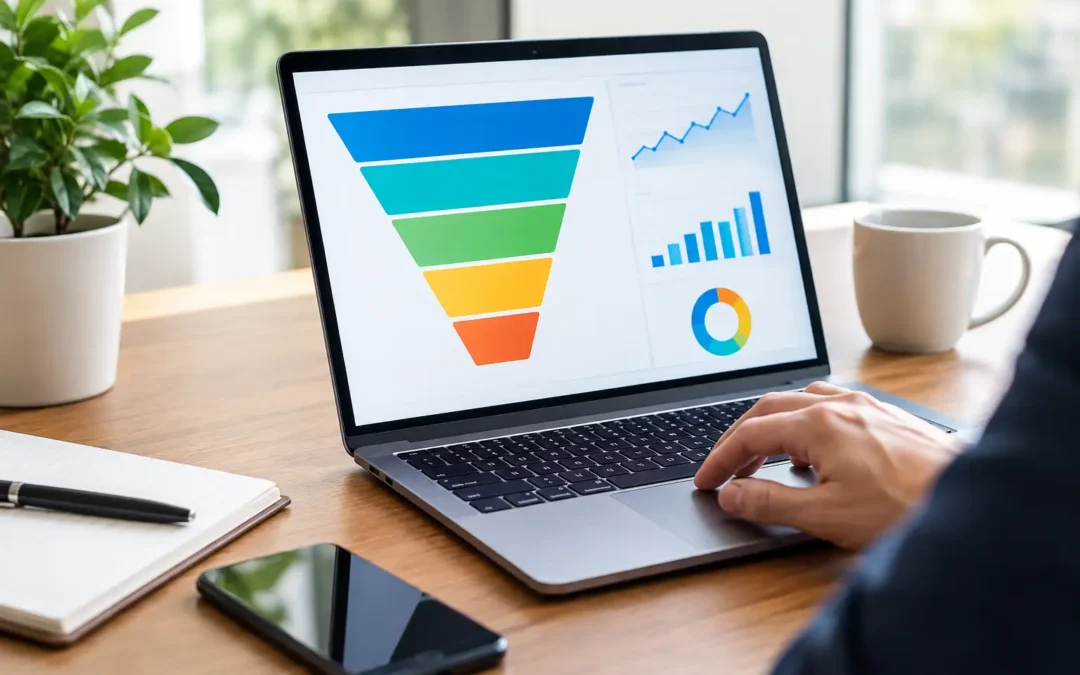
A campaign can generate thousands of website visits and still fail to produce meaningful revenue. The problem is rarely traffic alone. More often, businesses cannot see where potential customers lose interest, hesitate, or leave. This guide to marketing funnel analytics shows how to measure the full path from first click to closed deal, then use that intelligence to outperform competitors.
For growth-focused businesses, funnel analytics is not a reporting exercise. It is how you decide where to invest, what to fix, and which marketing channels are actually creating qualified opportunities. Rankings, clicks, and impressions matter, but they are only valuable when they move prospects toward a conversation, a quote request, a purchase, or a signed contract.
What Marketing Funnel Analytics Actually Measures
Marketing funnel analytics tracks how people progress through the stages that lead to a business outcome. Depending on your sales cycle, that outcome may be an ecommerce order, a booked consultation, a phone call, a form submission, or a sales-qualified lead.
The goal is to connect marketing activity to business performance. Instead of saying, “Organic traffic increased 20%,” you can answer the questions that matter: Did that traffic generate leads? Which service pages created the best opportunities? Which campaign produced customers at an acceptable cost? Where are we losing high-intent prospects?
A useful funnel usually has four broad stages: awareness, consideration, conversion, and retention. A local contractor may track someone from a Google search to a service-page visit, estimate request, phone consultation, and booked project. A professional services firm may track content engagement, consultation request, discovery call, proposal, and new client. The stages change, but the discipline does not.
Build Your Marketing Funnel Around Real Buyer Behavior
Do not force every channel into a generic funnel. Build the model around how your customers actually make decisions. A person searching “emergency plumber near me” has a different level of urgency than someone reading an article about preventing pipe damage. Treating both visits as equal will distort your reporting.
Start by identifying the meaningful actions that show progress. Awareness may include qualified organic visits, paid ad clicks, video views, or local map impressions. Consideration could include visits to service pages, case studies, pricing pages, comparison content, or multiple page views. Conversion may be a submitted form, tracked call, online purchase, scheduled appointment, or downloaded proposal.
Then define what happens after the website conversion. This is where many businesses lose visibility. A form fill is not automatically a lead worth celebrating. Track whether the contact was reached, qualified, quoted, won, or lost. If your CRM is disconnected from your website and ad platforms, marketing may look successful while the sales team is receiving low-value inquiries.
Your funnel should also account for long decision cycles. A commercial buyer might research for months before speaking to a vendor. In that case, measuring only last-click conversions will give too much credit to the final branded search or retargeting ad. The earlier SEO content, paid search campaign, and email follow-up may have done the work that created demand.
The Metrics That Reveal Funnel Leaks
A long dashboard is not a strategy. Focus on the metrics that explain movement from one stage to the next and expose weak points.
- Qualified traffic: Measure users from relevant locations, search terms, audiences, and devices, not just total sessions. A traffic spike from irrelevant queries does not create growth.
- Engagement with high-intent pages: Watch service-page views, pricing-page visits, return visits, scroll depth, and key button clicks. These actions help separate casual browsers from active buyers.
- Conversion rate: Track the percentage of visitors who complete a valuable action. Review it by channel, landing page, campaign, device, and location.
- Lead quality and close rate: Measure how many marketing leads become qualified opportunities and customers. This is the clearest test of whether a channel deserves more budget.
- Cost per lead and cost per acquisition: Paid media needs financial accountability. A cheap lead is expensive if it never closes; a higher-cost lead may be profitable if it consistently becomes revenue.
- Time to conversion: Identify how long prospects take to act. This helps set realistic expectations for SEO, nurture campaigns, and sales follow-up.
The most revealing metric is often the conversion rate between stages. If paid search produces strong landing-page engagement but few form submissions, the offer, form, trust signals, or call to action may be weak. If form submissions are high but qualified opportunities are low, targeting or lead screening needs attention. Analytics tells you where to look. It does not excuse guessing.
Attribution: Give Credit Without Fooling Yourself
Attribution is the process of assigning value to the marketing touchpoints that influence a conversion. It sounds technical, but the core issue is simple: buyers rarely convert after one interaction.
Last-click attribution gives all credit to the final channel before a conversion. It is easy to understand and useful for immediate optimization, especially for short sales cycles. But it can undervalue SEO content, social campaigns, display ads, and email nurture that introduced or educated the prospect earlier.
First-click attribution has the opposite weakness. It shows what created awareness but may overstate the impact of a channel that never moved the buyer further. Multi-touch models distribute credit across the journey and can offer a more balanced view, although they require cleaner data and thoughtful setup.
For most small and mid-sized businesses, the best approach is practical rather than perfect. Review first-touch, lead-creation, and last-touch data together. Compare that with CRM outcomes and direct feedback from the sales team. Ask new customers how they found you. If several sources point to the same channel or campaign, you have stronger evidence for a decision.
A Practical Guide to Marketing Funnel Analytics Setup
A reliable setup starts with clear conversion definitions. Agree on what counts as a lead, what counts as a qualified lead, and what counts as revenue. Marketing and sales must use the same language. Otherwise, reports become a debate over labels instead of a plan for growth.
Next, configure tracking for the actions that matter. This typically includes form submissions, click-to-call activity, appointment bookings, ecommerce purchases, quote requests, chat conversations, and key page interactions. Use unique thank-you pages or event tracking where appropriate, and test every conversion path yourself. A broken tracking tag can cause weeks of bad decisions.
Connect website analytics with advertising platforms and your CRM whenever possible. Use consistent campaign naming and source tracking so a lead from paid search is not mislabeled as direct traffic later. For offline businesses, import closed revenue or deal status back into your reporting. That closes the gap between a marketing lead and actual business value.
Privacy, consent requirements, and platform limitations add complexity. You may not be able to identify every user or attribute every touchpoint with absolute precision. That is normal. The priority is directional accuracy, consistent measurement, and decisions grounded in more than one data source.
Finally, create a reporting cadence. Weekly reviews are useful for campaign pacing, broken forms, budget changes, and major conversion drops. Monthly reviews should assess channel quality, funnel conversion rates, lead trends, and revenue outcomes. Quarterly reviews are where you make bigger calls on messaging, website improvements, market expansion, and budget allocation.
Turn Funnel Data Into Competitive Action
The value of analytics appears when you act on the findings. If organic traffic is growing but service-page conversions are flat, strengthen page copy, proof points, local relevance, calls to action, and page speed. If one paid campaign creates qualified leads at half the cost of another, shift budget with confidence instead of spreading spend evenly.
Look for patterns by device, geography, landing page, and audience. A mobile-heavy local campaign with poor mobile conversion may need a shorter form and a more prominent call button. A campaign generating leads outside your service area may need tighter location targeting. A high-performing page may reveal the exact message, offer, or customer pain point that should shape the rest of your marketing.
Do not optimize only for volume. More leads can burden a sales team without increasing revenue. The stronger goal is a funnel that produces the right prospects, gives sales the context to respond quickly, and improves efficiency as budgets scale.
WYK Web Solutions approaches analytics as a growth system, connecting search visibility, paid media, website performance, and lead reporting so businesses can see what is driving momentum and where competitors are leaving opportunity on the table.
Your next move does not need to be a complete rebuild. Choose one stage of the funnel, verify the data, identify the biggest leak, and fix it. Repeating that process turns marketing from a collection of activities into a measurable engine for stronger leads and sustained growth.