
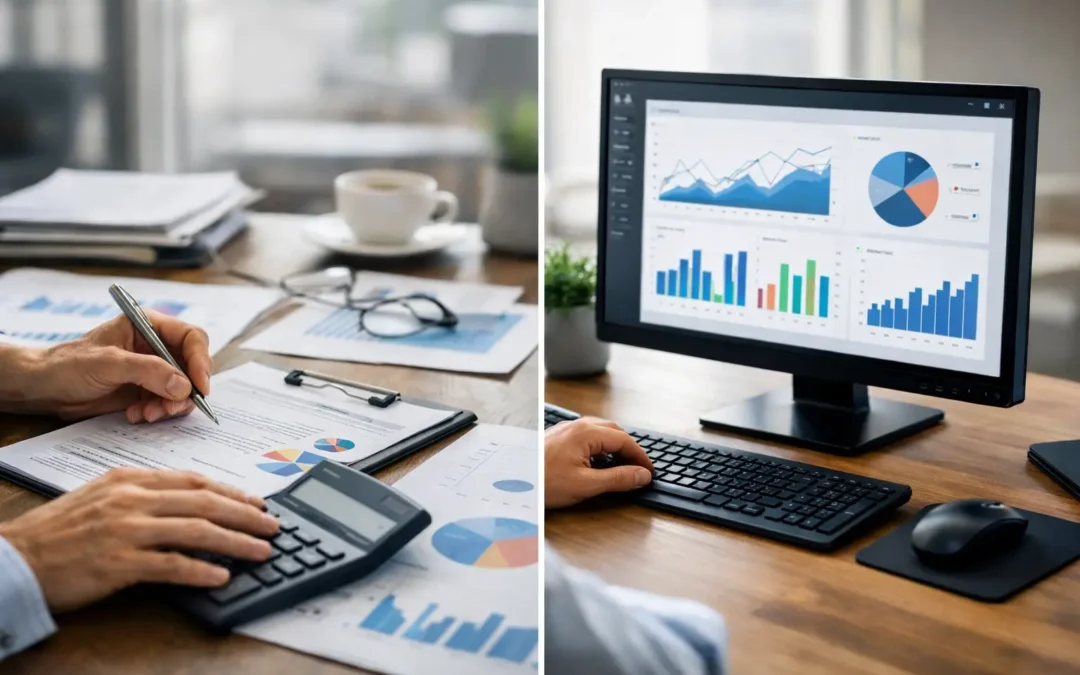
If your team is still pulling numbers from Google Ads, Analytics, social platforms, call tracking, and your CRM into one monthly spreadsheet, you already know the problem. Manual reporting versus marketing dashboards is not just a workflow choice. It is a decision about speed, clarity, and how confidently you can grow.
For small and mid-sized businesses, reporting should answer a simple question: what is driving leads and revenue right now? Too often, manual reports answer that question weeks late. By the time the spreadsheet is polished, the campaign has already moved, the budget has already been spent, and the opportunity to improve performance has already narrowed.
Why manual reporting slows down growth
Manual reporting usually starts with good intentions. A business owner wants clean numbers. A marketing manager wants to show progress. An agency or in-house team gathers data from multiple platforms and packages it into a report that looks organized and presentable.
The issue is not effort. The issue is delay.
When reporting depends on someone exporting data, cleaning rows, matching date ranges, checking formulas, and building charts, every insight arrives late. That lag matters in competitive markets where search positions shift, ad costs change, and lead quality can swing from one week to the next.
There is also a trust problem. Manual reports are vulnerable to human error. One incorrect filter, one broken formula, or one missed platform update can distort the story. Even when the numbers are technically correct, they often lack context. You may see clicks, impressions, and conversions, but not the relationship between channels, landing pages, phone calls, and actual sales outcomes.
That creates a dangerous pattern. Teams spend more time building reports than acting on them. Reporting becomes a backward-looking task instead of a tool for forward momentum.
Manual reporting versus marketing dashboards: what changes?
The real difference in manual reporting versus marketing dashboards is not that one uses spreadsheets and the other uses software. The bigger difference is how each approach supports decision-making.
Manual reporting is static. It captures a moment in time, usually after the fact. Dashboards are dynamic. They give you live or near-live visibility into what is happening across your marketing channels so you can respond while it still matters.
A good marketing dashboard brings your key performance data into one view. That might include organic traffic, keyword visibility, paid campaign spend, cost per lead, call volume, form submissions, booked appointments, and revenue attribution. Instead of chasing numbers across disconnected platforms, you see the bigger picture faster.
That speed has real business value. If paid search costs spike, you spot it early. If local SEO traffic climbs but conversions stall, you can investigate the landing page before a whole month is lost. If one service line starts outperforming another, you can reallocate budget with confidence instead of guessing.
For business owners and operators, that clarity is powerful. You do not need another stack of charts. You need faster answers on what is working, what is underperforming, and where to push harder.
Where manual reporting still has a place
This is not a case where manual reporting is always wrong. There are situations where it still makes sense.
If you run a very small operation with only one or two channels, a simple manual report may be enough for a while. If you need highly customized commentary for board meetings, investor updates, or annual planning, manual analysis can add useful interpretation that dashboards alone may not provide.
Manual reporting can also be helpful when you are auditing a campaign in depth. Sometimes a close look at raw data exposes patterns a dashboard does not surface on its own.
But that is the key distinction. Manual reporting works best as a supplement, not the main engine. It can support strategic review. It should not be the reason your team is waiting weeks to understand campaign performance.
What good marketing dashboards actually do
A strong dashboard is not just a prettier report. It is a decision tool.
The best dashboards focus on the metrics that affect growth, not vanity numbers that look impressive but mean little. More traffic sounds good, but qualified traffic is what matters. More impressions may feel encouraging, but cost per acquisition, lead quality, close rate, and channel attribution tell a stronger story.
That means dashboard design matters. If the dashboard is cluttered, overloaded, or built around platform metrics instead of business outcomes, it becomes noise. A useful dashboard should help you answer a few high-value questions quickly: Which channels are generating leads? Which campaigns are producing revenue? Where are we losing efficiency? What should we change this week?
For companies competing in local search or paid media, this can create a serious advantage. You are no longer waiting for an end-of-month recap to learn what the market already told you days ago.
The ROI question business owners actually care about
Most business owners do not want more reporting. They want more certainty.
They want to know whether SEO is generating real pipeline, whether PPC spend is profitable, whether social campaigns are helping conversions, and whether the website is pulling its weight as a lead-generation asset. This is where dashboards outperform manual reporting most clearly.
A dashboard can connect performance across the customer journey. Instead of seeing isolated platform metrics, you can compare traffic sources, lead actions, conversion rates, and outcomes in one place. That makes ROI easier to explain and easier to improve.
It also changes the tone of marketing conversations. Instead of debating disconnected numbers, your team can talk about business performance. Which channel deserves more budget? Which landing page needs work? Which service pages are winning organic visibility but failing to convert? Those are the conversations that drive revenue.
Common dashboard mistakes to avoid
Not every dashboard is worth trusting. Some are just automated clutter.
One common mistake is tracking everything. More data does not mean more insight. If the dashboard includes fifty metrics but does not tie them to leads, sales, or acquisition cost, it creates distraction.
Another mistake is failing to define attribution clearly. If your reporting does not explain where leads came from and how conversions are being counted, the numbers can look impressive while hiding weak performance.
There is also the risk of over-automation. A dashboard can show what happened, but it does not always explain why. That is why interpretation still matters. The strongest reporting setup combines dashboard visibility with expert analysis. Technology gives you speed. Strategy gives you direction.
This is where experienced agency support can make a difference. A team that understands SEO, paid media, web performance, and conversion tracking can build dashboards around the metrics that actually move your business, not just the metrics platforms make easy to display.
Choosing between manual reporting and dashboards
If your marketing is simple, your channels are limited, and your reporting needs are basic, manual reporting may still be workable for now. But if you are investing in SEO, paid ads, website optimization, local search, and multiple lead sources, manual reporting starts to hold your growth back.
That is the real business case in manual reporting versus marketing dashboards. One approach documents results after the fact. The other helps you improve results while campaigns are still live.
For growth-focused companies, that difference is hard to ignore. Better visibility leads to faster decisions. Faster decisions lead to smarter budget use. Smarter budget use leads to stronger returns.
If your current reporting process feels slow, fragmented, or overly dependent on spreadsheets, that is not a minor admin issue. It is a performance issue. Businesses that want to dominate search visibility, improve lead flow, and outpace competitors need reporting that moves at the same speed as the market.
At WYK Web Solutions, that mindset matters because digital growth is never driven by guesswork alone. It is driven by clear attribution, fast insight, and the ability to act before your competitors do.
The best reporting system is the one that helps you make stronger decisions with less delay. If your numbers are trapped in manual reports, your next move is already clear.