
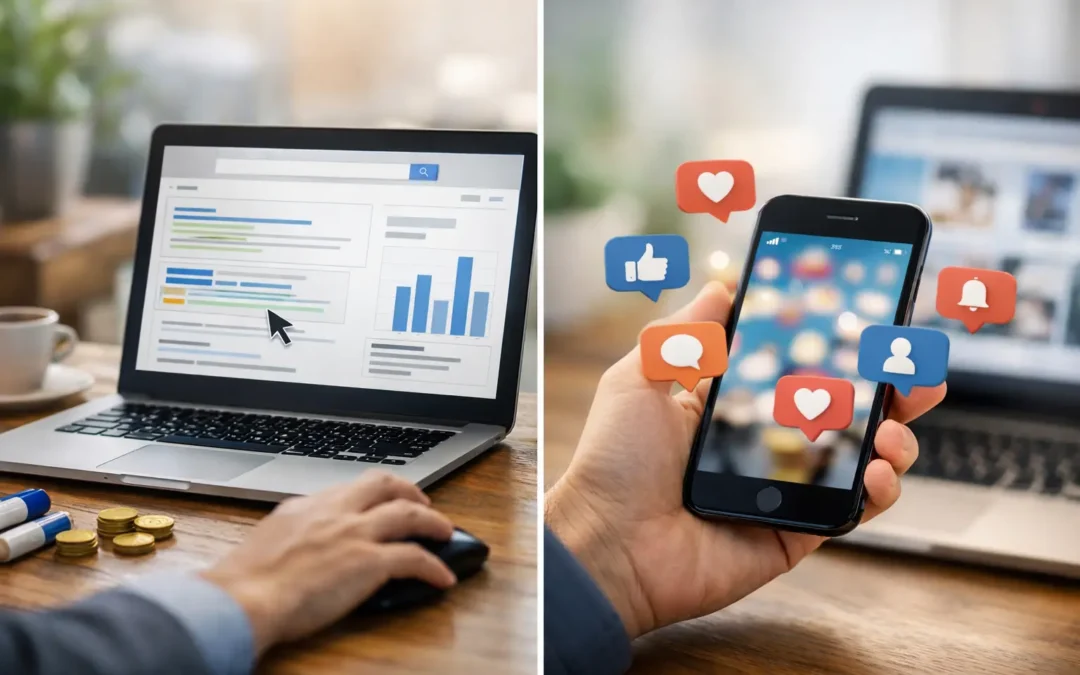
If your pipeline is soft and your competitors keep showing up first, the ppc vs social media debate stops being academic fast. You need leads, visibility, and a channel mix that actually moves revenue. The right answer is rarely about which tactic is better in general. It is about which one gives your business a stronger advantage right now, with your budget, your market, and your sales cycle.
For most small to mid-sized businesses, PPC and social media do very different jobs. One captures demand that already exists. The other helps create it, shape it, and keep your brand in front of the right audience. Treating them like interchangeable tactics is where budgets get wasted.
PPC vs social media: the real difference
PPC is intent-driven. People search because they want something now or soon. If someone types in a service, location, or problem, that click usually carries stronger buying intent than a casual scroll on a social platform. That makes PPC a high-speed channel for businesses that need qualified traffic quickly.
Social media works higher up the funnel most of the time. It builds familiarity, reinforces trust, and puts your offer in front of people who may not be actively searching yet. That does not mean it cannot drive leads. It can. But the lead path is often longer, and performance depends heavily on creative, targeting, offer strength, and follow-up.
This is why the question is not just ppc vs social media. It is demand capture vs demand creation. Fast intent vs repeated attention. Direct response vs relationship building.
When PPC wins
PPC is usually the stronger play when your buyers already know they need help. That is especially true for local services, legal, medical, home improvement, B2B specialties, and any category where people turn to Google with a clear problem. If a prospect is searching for a provider, that traffic is valuable because the need already exists.
PPC also wins when speed matters. A new business launching in a competitive market cannot wait six months for momentum. A company with a slow quarter may need leads this month, not next season. Paid search can put you in front of high-intent traffic almost immediately, assuming the campaign is set up correctly and the landing page is built to convert.
There is also more control in PPC. You can shape bids, geography, device targeting, ad copy, landing page paths, call tracking, and conversion reporting with precision. That level of control matters when leadership wants to know exactly what drove a lead and what each opportunity cost.
But PPC has trade-offs. Click costs can climb fast in competitive sectors. Weak landing pages can burn budget. Broad keywords can fill your CRM with junk. And if your tracking is poor, you may think a campaign is failing when it is actually influencing deals behind the scenes.
When social media wins
Social media performs best when your audience needs more warming up, your offer is visually compelling, or your brand has to earn attention before it earns a click. It is strong for lifestyle businesses, consumer brands, events, personal brands, franchises, real estate, recruiting, and businesses with memorable before-and-after outcomes or educational content.
It is also useful when your market is not actively searching in large volume. Some businesses sell services people do not think about until the right message appears in front of them. In those cases, social media can manufacture demand by putting a pain point, offer, or proof point into the feed at the right time.
Social platforms can be cost-effective at the top of the funnel, but they are less forgiving than many businesses expect. Creative fatigue happens quickly. Targeting can look sharp on paper and still bring weak traffic. Likes and reach can create false confidence if they are not tied to inquiries, booked calls, purchases, or assisted conversions.
The biggest mistake is treating social media as a branding exercise with no performance discipline. If the goal is growth, social campaigns need a clear offer, measurable conversion path, and consistent testing. Otherwise, you are paying for attention without a plan to turn that attention into revenue.
Cost, lead quality, and ROI
This is where business owners want a straight answer, and the honest answer is it depends on the maturity of your funnel.
PPC often brings higher-intent leads, but those leads can cost more upfront. Social media may generate cheaper clicks or lower-cost form fills, but lower cost does not always mean better ROI. If those leads need more nurturing, no-show more often, or close at a lower rate, the apparent savings disappear.
That is why lead quality matters more than platform vanity metrics. A $150 PPC lead that closes at 20 percent can be far more profitable than a $40 social lead that closes at 2 percent. The right comparison is not click-through rate versus impressions. It is cost per qualified lead, cost per booked appointment, cost per acquisition, and customer lifetime value.
For service businesses, PPC often dominates at the bottom of the funnel. Social media can still play a major role, but usually as an assist channel that builds trust before the search happens. A prospect may see your brand on Instagram or Facebook, remember the name, and then search for you later. If you only credit the last click, social media may look weaker than it really is.
PPC vs social media for local businesses
Local companies need visibility where buying intent is strongest. In many cases, that means PPC should get priority first, especially when local searches signal immediate need. If someone is looking for a contractor, dentist, accountant, or repair company in their area, showing up at the right moment matters.
That said, local businesses also benefit from social proof and community presence. Social media helps reinforce legitimacy. Reviews, project photos, team content, client wins, and educational posts can reduce friction and support conversion after someone discovers your business through search.
For a local growth strategy, PPC often brings the lead, while social media helps close the trust gap. That combination is hard to beat in crowded markets.
How to choose the right channel first
Start with buyer intent. If your prospects are actively searching for what you sell, PPC deserves serious attention. If demand is low or your offer needs stronger awareness, social media may need to lead.
Next, look at your sales cycle. Shorter cycles and urgent needs usually favor PPC. Longer cycles, higher-consideration purchases, and relationship-driven sales often benefit more from social media support.
Then assess your assets. PPC can underperform if your landing pages are weak, your offer is vague, or your conversion tracking is broken. Social media can stall if your creative is flat, your brand lacks proof, or your follow-up is slow. The channel is only as strong as the system behind it.
Budget matters too. A limited budget does not automatically mean social media is the better option. In some industries, a focused PPC campaign targeting the right terms and geography will produce better returns than spreading a smaller budget across social campaigns that need more testing to work.
Why the strongest strategy is often both
Businesses that want real momentum usually stop framing this as ppc vs social media and start building a smarter full-funnel strategy. PPC captures the people ready to act. Social media keeps your brand visible, expands audience reach, and supports remarketing. Together, they increase the chance that prospects choose you instead of the competitor they forgot to question.
This is where integrated reporting matters. If your campaigns are managed in silos, each channel will fight for credit instead of driving performance together. A search click may close the deal, but social media may have warmed the lead weeks earlier. Without attribution and clean tracking, channel decisions turn into guesswork.
At WYK Web Solutions, this is exactly where businesses gain ground. The advantage is not just running ads. It is connecting website performance, search intent, paid media, and reporting so every dollar has a job.
The better question to ask
Instead of asking which is better, ask which channel solves your current growth problem. If you need immediate, high-intent traffic, PPC is usually the sharper weapon. If you need stronger awareness, trust, and audience development, social media has a larger role to play. If you need consistent lead flow in a competitive market, the winning move is often a coordinated mix.
The businesses that grow fastest are not loyal to channels. They are loyal to outcomes. They test, measure, tighten, and scale what produces qualified leads and revenue. That is how you stop chasing marketing trends and start building a machine that can take market share.
The next step is not picking a side. It is getting honest about how your customers buy, where your funnel leaks, and which channel gives you the strongest path to visible, measurable growth.