
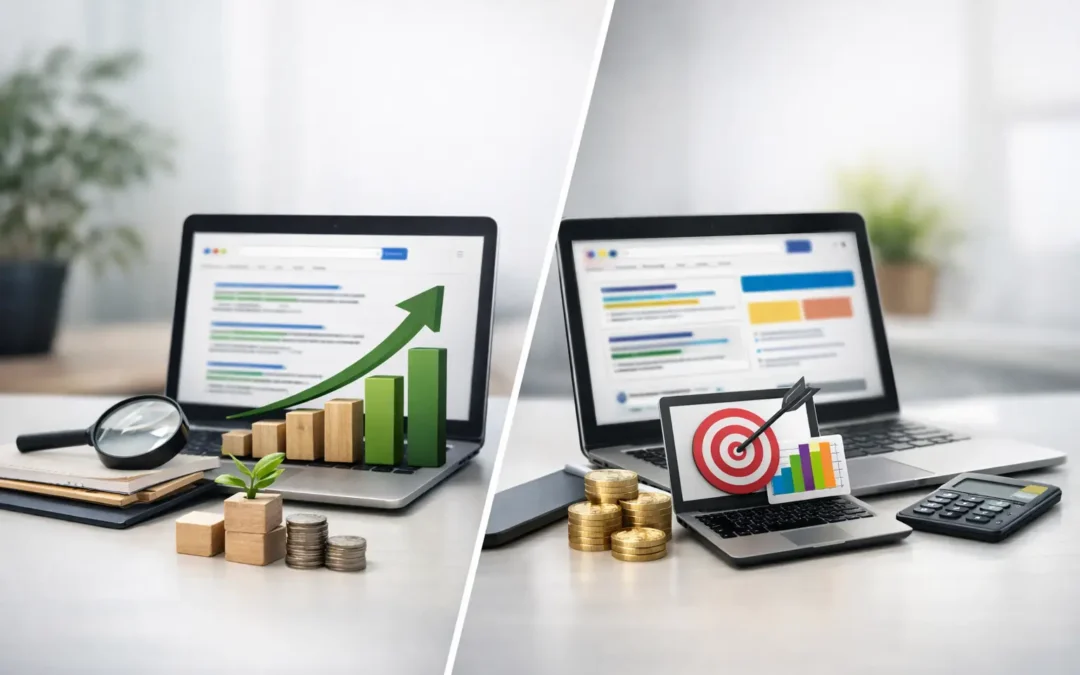
If your phone needs to ring this month, SEO vs Google Ads is not a theoretical marketing debate. It is a budget decision that affects lead flow, sales pace, and how hard your business has to fight for visibility in a crowded market.
Most business owners do not really want traffic. They want qualified leads, lower acquisition costs, and a search strategy that can hold ground against competitors. That is why the real question is not which channel is better in the abstract. It is which one gives your business the strongest competitive advantage right now, and which one keeps paying off six months from now.
SEO vs Google Ads: The core difference
SEO earns visibility in the organic search results. You invest in technical performance, content, site structure, authority, and local signals so your website ranks without paying for every click. Google Ads puts your business at the top of search results fast, but every visit comes at a price.
That difference shapes everything else. SEO is slower to build, but it compounds. Google Ads is faster to launch, but it stops the moment you stop funding it. One builds an asset. The other rents attention.
For most small to mid-sized businesses, that trade-off matters more than any platform feature. If your market is competitive, relying on one channel alone usually leaves money on the table.
When SEO is the smarter investment
SEO makes the most sense when you want durable growth instead of temporary spikes. If your business depends on ongoing search demand, organic rankings can become one of the strongest lead generation assets you own.
A well-optimized website keeps working after the initial investment. Strong service pages, location pages, technical cleanup, content strategy, and local optimization create momentum over time. That means your cost per lead can improve as rankings strengthen, especially in markets where click costs are high.
SEO also tends to build trust. Many users skip ads and go straight to the organic results because they see them as more credible. For law firms, contractors, clinics, consultants, and other service businesses, that trust can translate into better lead quality.
There is a catch. SEO is not instant. If your website is weak, your local presence is inconsistent, or your competitors have been investing for years, results take time. Anyone promising top rankings overnight is selling fantasy, not strategy.
SEO works best when:
Your business has a long sales horizon, your market has ongoing search volume, and you want to reduce dependency on paid traffic over time. It is especially effective when your website is already getting some traction and needs stronger structure, content, and authority to move up.
When Google Ads is the better move
Google Ads is built for speed. If you need leads now, it can put your business in front of high-intent searchers quickly. You can target specific services, locations, times of day, devices, and search terms with far more control than SEO allows.
That speed is powerful for businesses launching a new service, entering a new market, or trying to fill a pipeline fast. It is also useful when organic rankings are weak and waiting six months is not realistic.
Paid search gives you testing power too. You can learn which keywords convert, which offers get clicks, and which landing pages produce real leads. That data can shape both your ad strategy and your SEO priorities.
But Google Ads has its own pressure points. In competitive sectors, cost per click can climb fast. Poor campaign structure, weak landing pages, and broad targeting can burn through budget without producing revenue. Visibility is easy to buy. Profit is not.
Google Ads works best when:
You need immediate visibility, you have a clear offer, and your sales process can convert traffic efficiently. It is strongest when campaigns are tightly managed and backed by solid tracking, not just impressions and click numbers.
Cost: upfront spend vs long-term efficiency
This is where most businesses get stuck. SEO often feels expensive because you pay before the full return shows up. Google Ads feels easier to justify because leads can start coming in almost immediately.
The problem is that paid search can become more expensive over time if competition drives up bids. SEO often moves in the opposite direction. Once rankings improve, your marginal cost per click is effectively zero, even though maintenance still matters.
That does not mean SEO is cheaper in every case. If your website needs major redevelopment, technical fixes, and a serious content push, the early investment can be significant. On the other hand, a well-run Google Ads campaign with a strong landing page can produce profitable leads quickly, even with a modest budget.
The right question is not which channel costs less. It is which one gives you the better return at your current stage.
Lead quality is not always equal
A click is not a lead, and a lead is not revenue. That is where the SEO vs Google Ads decision gets more nuanced.
SEO traffic often captures users who are researching, comparing, and building trust before they contact you. That can mean fewer low-intent clicks and stronger conversion quality, particularly for service pages that match clear search intent.
Google Ads can also deliver excellent leads, but campaign quality determines everything. If targeting is too broad, you will attract people outside your service area, shoppers looking for the cheapest option, or users with the wrong need entirely. Strong keyword selection and negative keyword management make a major difference.
In some industries, paid leads convert better because the user is acting immediately. In others, organic leads close at a higher rate because the prospect has already done more homework. That is why attribution matters. Businesses that only look at raw lead volume often back the wrong channel.
SEO vs Google Ads for local businesses
For local companies, the answer is rarely all SEO or all paid search. Local SEO helps you rank in map results and organic listings for searches tied to geography and intent. That is critical if you want to dominate your service area over time.
Google Ads can then amplify that visibility for your highest-value terms, seasonal promotions, or urgent services. If you are a roofer after a storm, a dentist promoting a new patient offer, or a law firm targeting a profitable case type, paid search can create immediate momentum while SEO builds a stronger long-term foundation.
This is where integrated strategy wins. A business with a fast, search-optimized website, strong local signals, conversion-focused landing pages, and clean tracking has a much better shot at outperforming competitors across both channels.
The biggest mistake: choosing based on opinion
Too many businesses choose SEO or Google Ads based on bias. Someone had a bad agency experience. Someone heard ads are too expensive. Someone assumes SEO is free traffic.
None of that is strategy.
The right channel mix depends on your timeline, market competition, website quality, average deal value, close rate, and available budget. A company selling high-ticket services can justify aggressive paid acquisition much more easily than a business with thin margins. A company with a weak website will struggle in both channels until the site is fixed.
This is also why reporting matters. If you cannot see where leads come from, which pages convert, and which campaigns influence closed business, you are making decisions in the dark.
So which should you choose?
If you need leads quickly, start with Google Ads. If you want long-term visibility and stronger cost efficiency over time, invest in SEO. If you want to build a real search advantage, do both with a clear plan.
That combined approach is often the strongest move. Paid search drives immediate traffic and tests demand. SEO builds authority, reduces dependence on ad spend, and creates a compounding asset. Together, they give your business both speed and staying power.
At WYK Web Solutions, this is exactly where businesses gain ground. Not by chasing clicks for the sake of activity, but by aligning website performance, search visibility, paid traffic, and attribution around lead generation that actually moves the business forward.
The best channel is the one that fits your goals, your margins, and your market pressure. If your competitors are already showing up everywhere your customers search, standing still is a decision too – and it is usually the expensive one.