
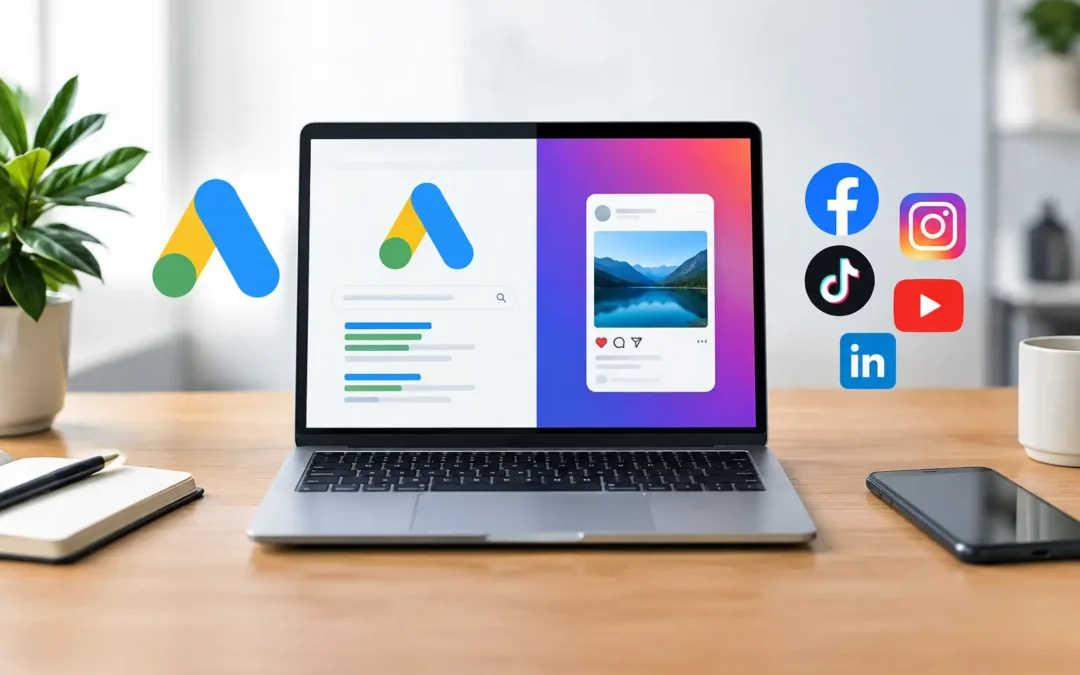
A homeowner searching “emergency plumber near me” and a homeowner scrolling past a renovation video are not in the same buying moment. That distinction is the core of Google Ads versus social advertising. One channel captures demand when people are actively looking. The other creates demand by putting a relevant offer in front of people before they start searching.
For small and mid-sized businesses, the wrong choice can drain budget fast. The right choice can put your brand ahead of competitors, fill the pipeline, and show exactly which campaigns are producing qualified calls, form submissions, and booked appointments. Neither platform wins in every scenario. The best investment depends on your sales cycle, offer, market, margins, and ability to follow up.
Google Ads Versus Social Advertising: The Core Difference
Google Ads is intent-driven advertising. A prospect enters a search because they want an answer, a provider, a quote, or a product right now. Your ad can appear at the precise moment they are evaluating options. This makes search advertising especially powerful for local services, professional firms, B2B providers, and businesses with an immediate or well-defined need.
Social advertising is interruption-based, but that does not make it less valuable. Platforms such as Facebook, Instagram, LinkedIn, and TikTok place ads in front of audiences based on interests, demographics, behavior, job roles, engagement, and customer data. A person may not be searching for a new accountant, commercial contractor, or skincare product today. A strong social campaign can make them aware of the need, introduce a compelling offer, and build familiarity before they are ready to act.
Think of Google Ads as demand capture and social advertising as demand generation. Businesses that need leads this month often start with search. Businesses that need to build a larger future market cannot afford to ignore social.
When Google Ads Has the Competitive Advantage
Google Ads is built for high-intent traffic. If someone searches “personal injury lawyer consultation,” “HVAC repair near me,” or “best payroll software for small business,” they have already identified a problem. Your campaign does not need to persuade them that the category exists. It needs to prove that your company is the best next step.
That advantage is strongest when keywords clearly signal commercial intent. Search campaigns can target location, device, time of day, audience signals, and exact service terms. A local roofing company, for example, can focus spend on homeowners in its service area who are searching for roof replacement estimates instead of paying for broad exposure outside its market.
Google Ads also gives businesses tighter control over the search terms they want to pursue and the terms they want to exclude. Negative keywords help prevent wasted spend. If you sell premium services, you can reduce exposure to searches for jobs, DIY instructions, free options, or unrelated products. That level of control matters in competitive categories where every click has a cost.
The trade-off is that demand must already exist. Google cannot create more searches for a niche offer simply because you increase your budget. High-intent keywords are also competitive, and cost per click can rise quickly in legal, home services, finance, healthcare, and other crowded markets. Winning requires more than bidding aggressively. Your landing page, offer, call handling, tracking, and follow-up process must do their jobs.
Google Ads performs best when urgency is high
Search advertising should be a front-runner when customers need a solution quickly, know what they are looking for, and can take a measurable action online. Calls, estimate requests, demo bookings, purchases, and appointment requests are all strong conversion events.
It is also the better first channel when sales teams need lead quality over raw volume. A lower number of people searching for a specific service can still produce more valuable opportunities than a large social audience with limited buying intent.
Where Social Advertising Creates More Opportunity
Social advertising earns its value before the search begins. It is particularly effective when your product needs explanation, your visual proof is persuasive, or your audience can be identified by lifestyle, role, interest, or behavior.
A remodeling company can show dramatic before-and-after projects. A fitness studio can promote a limited-time trial with customer testimonials. A B2B technology firm can reach operations leaders with a practical lead magnet or event invitation. In each case, the ad does more than announce a service. It creates recognition and gives prospects a reason to engage.
Social platforms are often more effective than search when people do not use a clear keyword to describe what they need. A business selling a new type of product, an elective service, or a premium lifestyle offering may find that demand is too vague for a search-only strategy. Social lets the brand frame the problem and present the solution first.
Retargeting is another major strength. Someone who visits your service page, watches a video, abandons a form, or interacts with your content can see a follow-up ad later. This keeps your business visible while the prospect compares options or waits for the right time to act. For longer buying cycles, that repeated exposure can be the difference between being remembered and being replaced by a competitor.
The challenge is that social engagement can look better than it performs. Likes, video views, and clicks do not automatically equal revenue. Campaigns need a clear offer, a friction-free conversion path, and reporting that connects leads to real sales outcomes. Without that discipline, social advertising can become expensive brand activity with no accountable return.
Cost, Targeting, and Lead Quality
Comparing cost per click alone is a mistake. Social clicks are often cheaper than Google search clicks, but a cheaper click is only valuable when it produces a qualified prospect. A $4 Google click that generates a booked consultation can outperform a $1 social click that produces casual curiosity.
The better question is cost per qualified lead, then cost per acquired customer. That means tracking calls, forms, booked meetings, closed deals, and revenue whenever possible. Businesses that stop at platform metrics usually make budget decisions with incomplete information.
Google targeting is strongest around declared intent. Prospects tell the platform what they want through their searches. Social targeting is strongest around audience discovery and message testing. You can test different pain points, offers, industries, creative angles, and customer segments before prospects ever search for your name.
Lead quality also depends on the offer. “Get a free quote” may attract ready-to-buy Google searchers. On social, a lower-commitment offer such as a guide, checklist, consultation, webinar, or introductory promotion may work better because the audience is earlier in the decision process. Trying to force a cold social audience into a high-commitment conversion too soon can weaken performance.
Build the Right Channel Mix for Your Business
The decision is rarely Google Ads or social advertising forever. It is usually a question of where to place the first dollar, what role each channel should play, and when results justify expansion.
Start with Google Ads if your business has proven search demand, clear service keywords, strong local competition, and a direct path from search to inquiry. This is often the fastest route to high-intent leads. Make sure the campaign sends traffic to focused landing pages rather than a generic homepage, and track every meaningful phone call and form submission.
Start with social advertising if you are launching a new offer, selling visually, targeting a narrow professional audience, or facing a long consideration cycle. Use video, testimonials, case examples, and clear offers to build trust. Then retarget engaged visitors with a stronger call to action as they move closer to a decision.
For many growth-focused businesses, the strongest approach is integrated. Social campaigns introduce the brand and build audience pools. Google Ads captures the searches that follow. Retargeting keeps both groups engaged. SEO supports long-term visibility so your lead flow does not depend entirely on paid traffic. This is how paid media becomes a system rather than a collection of disconnected ads.
Four questions to ask before allocating budget
- Are customers actively searching for our service right now?
- Can we show the value of our offer quickly through visuals, proof, or education?
- What is a qualified lead worth to our business, not just what does a click cost?
- Can our team respond to inquiries fast enough to convert paid traffic into revenue?
If the answer to the first question is yes, search should likely command a meaningful share of budget. If the second is stronger, social deserves a serious test. If both are true, separating the channels into clear roles will produce better data and better decisions.
At WYK Web Solutions, we look beyond clicks to connect campaign strategy with landing pages, search visibility, conversion tracking, and lead quality. The goal is not to spend more. It is to take market share from competitors who are spending without a plan.
Choose the channel that matches your buyer’s current mindset, then measure what happens after the click. That is where advertising stops being an expense and starts becoming a growth engine.